Links

This form does not yet contain any fields.
    2.c3 Sicilian 2011 European Team Championship 2011 Russian Championship 2012 Capablanca Memorial 2012 Chess Olympiad 2012 European Women's Championship 2012 London Chess Classic 2012 U.S. Junior Championship 2012 U.S. Women's Championship 2012 US Championship 2012 Women's World Chess Championship 2012 World Rapid and Blitz Championships 2013 Alekhine Memorial 2013 U.S. Championship 2013 World Championship 60 Minutes A. Muzychuk A. Sokolov aattacking chess Abby Marshall Accelerated Dragon ACP Golden Classic Adams Aeroflot 2010 Aeroflot 2011 Aeroflot 2012 Aeroflot 2013 Agrest Akiba Rubinstein Akiva Rubinstein Akobian Alejandro Ramirez Alekhine Alekhine Defense Alekseev Alena Kats Alex Markgraf Alexander Alekhine Alexander Grischuk Alexander Ipatov Alexander Morozevich Alexander Onischuk Alexander Stripunsky Alexandra Kosteniuk Alexei Shirov Almasi Amber 2010 Amber 2011 Amos Burn Anand Anand-Gelfand 2012 Anand-Gelfand World Championship Match Anand-Topalov 2010 Anastasia Bodnaruk Anatoly Karpov Andrei Volokitin Andrew Martin Android apps Anish Giri Anna Ushenina Anna Zatonskih Anti-Marshall Lines Anti-Moscow Gambit Antoaneta Stefanova apps April Fool's Jokes Archangelsk Variation Arkadij Naiditsch Arne Moll Aron Nimzowitsch Aronian Aronian-Kramnik 2012 Artur Yusupov Astrakhan Grand Prix 2010 attack attacking chess Austrian Attack Averbakh Baadur Jobava Bacrot Bangkok Chess Club Open Bazna 2011 Becerra Beliavsky Benko Gambit Bent Larsen Berlin Defense Biel 2012 Bilbao 2010 Bilbao 2012 bishop endings Bishop vs. Knight Blackburne blindfold chess blitz Blumenfeld Gambit blunders Bobby Fischer Bologan Book Reviews books Boris Gelfand Boris Spassky Borislav Ivanov Boruchovsky Botvinnik Botvinnik Memorial Breyer Variation brilliancy British Championship Bronstein Browne Brunello Budapest Bundesliga Camilla Baginskaite Campomanes Candidates 2011 Candidates 2011 Candidates 2012 Candidates 2013 Capablanca Carlsen Caro-Kann cartoons Caruana Catalan Cebalo Charlie Rose cheating Cheparinov chess and education chess and marketing chess cartoons chess history chess in fiction Chess Informant chess psychology chess ratings chess variants Chess960 ChessBase DVDs ChessBase Shows ChessLecture Presentations ChessVibes ChessVideos Presentations Chigorin Variation Chinese Chess Championship Christiansen Christmas Colle combinations Commentary computer chess computers correspondence chess Corsica Cyrus Lakdawala Danailov David MacEnulty David Navara Davies Deep Blue Deeper Blue defense Delchev Ding Liren Dmitry Andreikin Dmitry Gurevich Dortmund 2010 Dortmund 2011 Dortmund 2012 Dortmund 2012 Doug Hyatt draws dreams Dreev DVD Reviews DVDs Dvoirys Dvoretsky Easter Edouard Efimenko Efstratios Grivas endgame studies endgames Endgames English Opening Esserman Etienne Bacrot European Club Cup 2012 European Individual Championship 2012 Exchange Ruy Fabiano Caruana Falko Bindrich farce FIDE Grand Prix FIDE ratings Fier fighting for the initiative Finegold Fischer football Francisco Vallejo Pons French Defense Ftacnik Gajewski Gaprindashvili Garry Kasparov Gashimov Gata Kamsky Gelfand Geller Georg Meier GGarry Kasparov Gibraltar 2011 Gibraltar 2012 Gibraltar 2013 Giri Greek Gift sacrifice Grenke Chess Classic 2013 Grinfeld Grischuk Grob Gruenfeld Defense Grünfeld Defense Gulko Gunina Guseinov Gustafsson Haworth Hedgehog Hennig-Schara Gambit Henrique Mecking HHou Yifan highway robbery Hikaru Nakamura Hilton Hjorvar Gretarsson Hort Horwitz Bishops Hou Yifan Houdini 1.5a Howard Staunton humor Humpy Koneru Ian Nepomniachtchi Icelandic Gambit Igor Lysyj Iljumzhinov Ilya Nyzhnyk Informant Informant 113 Informant 114 Informant 115 Informant 116 insanity Inside Chess Magazine Ippolito IQP Irina Krush Ivanchuk J. Polgar Jacob Aagaard Jaenisch Jaideep Unudurti Jakovenko Jan Timman Jay Whitehead Jeremy Silman Jimmy Quon John Watson Jonathan Hawkins Jonathan Speelman Jose Diaz Judit Polgar Kaidanov Kamsky Karjakin Karpov Karsten Mueller Kasimdzhanov Kasparov Kavalek Ken Regan Keres KGB Khalifman King's Gambit King's Indian King's Tournament 2010 Kings Tournament 2012 KKing's Gambit KKing's Indian Klovans Korchnoi Kramnik Kunin Larry Evans Larry Parr Lasker Lasker-Pelikan Latvian Gambit Laznicka Le Quang Liem Leko Leonid Kritz lessons Lev Psakhis Levon Aronian Lilienthal Linares 2010 Lombardy London 2009 London 2010 London 2011 London Grand Prix London System Luke McShane Macieja Magnus Carlsen Main Line Ruy Malakhov Mamedyarov Marc Arnold Marc Lang Marin Mariya Muzychuk Mark Crowther Marshall Marshall Gambit Masters of the Chessboard Mateusz Bartel McShane Mega 2012 Mesgen Amanov Michael Adams Miguel Najdorf Mikhail Tal Mikhalchishin Miles Minev miniatures MModern Benoni Modern Modern Benoni Moiseenko Morozevich Morphy Movsesian Müller music Nadareishvili Naiditsch Najdorf Sicilian Nakamura Nanjing 2010 Navara Negi Neo-Archangelsk Nepomniachtchi New In Chess Yearbook 104 New York Times NH Tournament 2010 Nigel Short Nikita Vitiugov Nimzo-Indian NNotre Dame football Norway Chess 2013 Notre Dame football Notre Dame Football Nov. 2009 News Nyback Nyzhnyk Olympics 2010 Open Ruy opening advice opening novelties Openings openings P.H. Nielsen passed pawns Pavel Eljanov pawn endings pawn play pawn structures Pesotskyi Peter Heine Nielsen Peter Leko Peter Svidler Petroff Philadelphia Open Phiona Mutesi Pirc Piterenka Rapid/Blitz Polgar Polugaevsky Ponomariov Ponziani Potkin poultry Powerbook 2011 progressive chess QGD Tartakower QQueen's Gambit Accepted queen sacrifices Queen's Gambit Accepted Radjabov Ragger Rapport Rashid Nezhmetdinov rating inflation ratings Regan Reggio Emilia 2010 Reggio Emilia 2011 Reshevsky Reti Rex Sinquefield Reykjavik Open 2012 Richard Reti Robert Byrne robot chess Robson Roman Ovetchkin rook endings RReggio Emilia 2011 rrook endings RRuy Lopez RRuy Lopez sidelines Rubinstein rules Ruslan Ponomariov Russian Team Championship Rustam Kasimdzhanov Ruy Lopez Ruy Lopez sidelines Rybka Rybka 4 sacrifices Sadler Sakaev Sam Sevian Sao Paulo/Bilbao 2011 Sao Paulo/Bilbao 2012 satire Savchenko Schliemann Scotch Four Knights Searching for Bobby Fischer Seirawan self-destruction Sergei Tiiviakov Sergey Karjakin Sergey Shipov Shakhriyar Mamedyarov Shankland Shipov Shirov Short Sicilian sitzfleisch Slav Smith-Morra Gambit Smyslov Spassky spectacular moves Speelman sportsmanship Spraggett St. Louis Invitational stalemate Staunton Stonewall Dutch Suat Atalik Super Bowl XLIV Sutovsky Sveshnikov Sveshnikov Sicilian Svetozar Gligoric Svidler sweeper sealer twist Swiercz tactics Tactics Taimanov Tal Tal Memorial 2009 Tal Memorial 2010 Tal Memorial 2011 Tal Memorial 2012 Tal Memorial 2012 Tarjan Tarrasch Tashkent Teimour Radjabov The Chess Players (book) The Week in Chess Three knights time controls Timman Timur Gareev Tomashevsky Tony Miles Topalov traps types of chess players underpromotion Unive 2012 University of Notre Dame upsets US Championship 2010 US Championship 2011 USCL V. Onischuk Vachier-Lagrave Vallejo van der Heijden van Wely Vasik Rajlich Vasily Smyslov Vassily Ivanchuk Velimirovic Attack Veresov Veselin Topalov video videos Vienna 1922 Viktor Korchnoi Viswanathan Anand Vitaly Tseshkovsky Vitiugov Vladimir Kramnik Vladimir Tukmakov Wang Hao Wang Yue Watson Welcome Wesley Brandhorst Wijk aan Zee 2010 Wijk aan Zee 2011 Wijk aan Zee 2012 Wijk aan Zee 2013 Willy Hendriks Winawer French Wojtkiewicz Women's Grand Prix Women's World Championship World Cup World Cup 2009 World Cup 2011 World Cup 2011 World Senior Championship WWijk aan Zee 2012 Yasser Seirawan Yates Yermolinsky Yevseev Yuri Averbakh Yuri Razuvaev Zaitsev Variation Zhao Xue Zug 2013 Zukertort System Zurich 1953 Zurich 2013

    Entries in blunders (9)

    Monday
    May212012

    Anand Levels Gelfand and the Match, Winning Game 8 in 17 Moves

    An odd world championship match just grew odder still. After 19 years without a win in classical chess against Viswanathan Anand, Boris Gelfand's patient, solid strategy paid off in game 7. He won and took the lead over the champion, 4-3, with just five games to go. At this point he could expect Anand to play more aggressively and to start throwing the kitchen sink at him, so it would have made sense to keep solid, weather the storm and maybe even give Anand the chance to overextend.

    So what happened? Just the opposite. Perhaps dizzy from success, Gelfand played uncharacteristically risky chess, like a man who had completely lost his sense of danger. The game grew wild in a hurry, and then Gelfand badly miscalculated a short sequence and lost immediately. What's especially odd is that if Gelfand's normal sense of danger had been present, he would have been more suspicious - surely Anand wouldn't overlook something so simple, would he? He didn't.

    The game was thus a disaster, but objectively Gelfand is still in reasonable shape in the match. It's tied at 4-4, with four games to go, and he can head into the rest day with the encouraging awareness that he can beat Anand. For Anand, today's game was an obvious positive, so if he can neutralize Gelfand's opening in game 9 he can look forward to the rest of the match with confidence.

    My back allowing, subscribers can look forward to my annotations and video and later this evening.


    Sunday
    May202012

    Krush Wins Women's Title in a Ghoulish Tiebreak

    Anna Zatonskih and Irina Krush were tied at the end of the U.S. Women's Championship round-robin, so today they played a tiebreaker. It would go to an Armageddon game if necessary, but first they played a pair of G/25 (plus 5 second increments per move) rapid games. In the first, Zatonskih got nothing with White, pressed anyway, and lost. In the rematch, however, she played very well and obtained a winning attack. To break the attack, Krush offered an exchange, but Zatonskih went for more. Krush's reply was a blunder, and with a simple two-mover her opponent would win a rook, equalize the scores, and go on to the Armageddon game.

    Instead, after thinking for three minutes, Zatonskih missed it. By this point Krush had seen it and could be seen exhaling in relief, though even after this her position was awful. Zatonskih didn't handle the technical task to perfection, but was slowly but surely getting the job done. And then...she simply hung a rook. Maybe it was the sort of OTB equivalent of "pre-move": she expected that Krush was going to do something else, and simply carried out her intended move anyway, not noticing before reflexively executing what was now a blunder.

    A horrific reminder, in case anyone needed it, that errare humanum est.

    Tuesday
    May082012

    2012 US Championship, Round 1: The Favorites Win

    With the exception of a single draw between two closely rated opponents, the higher-rated player won every game in the first round of the 2012 U.S. Championship.

    Top seed Hikaru Nakamura blew the dust off his opening books, trotting out the hoary Evans Gambit against Robert Hess. In return, Hess sent the game even further into obscurity by employing the Stone-Ware Defense (1.e4 e5 2.Nf3 Nc6 3.Bc4 Bc5 4.b4 Bxb4 5.c3 Bd6!?). It looks disgusting, but has been tried by some elite players including Alexander Grischuk. Further, the ...Bd6 concept is known from other openings as well, including the Spanish Four Knights.

    Anyway, Nakamura had enough for the pawn, which Hess soon returned, and had been gradually increasing his advantage when he played 26.Bd5. Hess was a pawn down but maybe not yet lost when he came up with the tactically flawed plan of 26...Qb6, aiming to regain the pawn with ...Qb1+ and ...Qxa2. The good news is that Hess did regain the pawn, the bad news is that it got him mated.

    I have to admit that I find Gata Kamsky's chess inscrutable. Now, in saying that I'm not immodestly claiming to understand everything that goes on in the games of other top players; of course not. But generally speaking, I've got a pretty good sense of what they're doing - not an infallible sense, and understanding x doesn't mean that one can successfully do x, either. Maybe I can't hit their high notes and my voice isn't as rich and powerful, but I can carry the melody. With Kamsky's chess, I'm often tone-deaf!

    That isn't meant as an insult in any way; it's just a confession. I remember a match I played some years ago with a player roughly my rating. After the match, I admitted to my opponent that I couldn't guess any of his moves (at least it seemed that way); to my surprise, he told me the reverse: he guessed all (or at least almost all) of mine! The oddity of the story is that I won the match by a convincing margin and dominated most of the games. (Overall though, we were very close in strength; if I was better, it wasn't by much.) So to sum up: generally understanding what a player is up to doesn't mean that one can play as well as that person, and not generally understanding that player doesn't automatically indicate that the one lacking understanding is weaker.

    The reason for that story, aside from a desire to express some thoughts, was to say that I found the first part of Kamsky's win over Alejandro Ramirez baffling. It looked like he met Ramirez's Kan Sicilian in a very routine and accommodating way, not doing anything to make Black's life difficult. He built up slowly, allowed Black to achieve ...b5, retreated pieces to the back rank, and took time out for prophylactic moves like 17.b3 and 20.h3. And yet after 22.Nxf4 he was comfortably better, and after 22...Qh4?! 23.Nd5 his advantage was serious. Ramirez sacrificed the exchange for a pawn, but it wasn't enough. Kamsky was grinding him down and was well on the way to victory when Ramirez blundered a piece with 38...Bf5??

    In other games, Varuzhan Akobian ground down Yasser Seirawan on the white side of a Queen's Gambit Declined, Alex Lenderman won a long and complicated Russian System Gruenfeld against Ray Robson (again with White), Yuri Shulman drew a long Bogo-Indian with Gregory Kaidanov, and then there was this:

    Alexander Stripunsky - Alex Onischuk:

    1.e4 c6 2.Nc3 d5 3.Nf3 Bg4 4.h3 Bxf3 5.Qxf3 e6 6.g3 Nd7 7.Qe2 d4N 8.Nb1 h5 9.h4 g5 10.hxg5 Qxg5

    11.d3?? and White resigned without waiting to see what would happen next.

    Round 2 Pairings:

    Seirawan (0) - Hess (0)
    Ramirez (0) - Nakamura (1)
    Robson (0) - Kamsky (1)
    Onischuk (1) - Lenderman (1)
    Kaidanov (1/2) - Stripunsky (0)
    Akobian (1) - Shulman (1/2)

    Wednesday
    Aug312011

    World Cup 2011: Round 2, Day 1

    With most of the favorites through, the matches are going to be more closely contested from here on out. Unsurprisingly, there were a lot of draws today, and some were quite short - apparently some players have decided to save energy and make their big push in the rapid playoffs in a couple of days.

    That's not at all to say that no one tried; far from it, and the ultimate fighter today was Vassily Ivanchuk, who with Black squeezed Evgeny Alekseev for 97 moves until a blunder finally popped out and he won. Other big guns collecting the full point were Vugar Gashimov (I annotate this game), Teimour Radjabov and Alexander Morozevich. Some 2700s lost, too, including Alexei Shirov (to Vladimir Potkin - I've annotated that game), Etienne Bacrot (to Anton Filippov), and - in unbelievable fashion - Francisco Vallejo Pons, to Lazaro Bruzon. That one almost has to be seen to be believed, so that game also appears in the annotated game link.

    All the Americans (and all the "honorary Americans" as well) drew their games.

    Links: Official site (with excellent live video coverage) here, Wikipedia brackets here (scroll down), and the three games I annotate are here. (Real annotations, too, at one point verging on the Hübnerian. You're welcome.)

    Tuesday
    Dec212010

    Two Excerpts from the European Rapid Championship

    The European Rapid Championship took place in Warsaw this past weekend, and with tons of strong players there were many fine games and exciting moments. Not all the games were so impressive, however - witness this:

    Tomasz Markowski (2625) - Radoslaw Wojtaszek (2726) (Round 8):

    1.Nf3 d5 2.c4 c6 3.d4 Nf6 4.Qb3 dxc4 5.Qxc4 Bg4 6.Nc3 Nbd7 7.e4 Bxf3 8.gxf3 e5 9.Be3 Bd6 10.0-0-0

    This line has fared pretty well for White, but Black's position is certainly playable.

    10...exd4

    This has only been played once before, by Boris Gelfand against Ruslan Ponomariov in the finals of the 2009 World Cup. Ponomariov recaptured with the bishop and eventually won a hard battle (though he lost the war, as Gelfand eventually won the match and the tournament), but Black was not in trouble at this point.

    11.Qxd4

    And now Wojtaszek, all 2726 rating points' worth of him, played 11...Qc7?? and resigned after 12.Qxd6. There's hope for us all...or is it that we're all hopeless, at least sometimes?


    Here's another one:

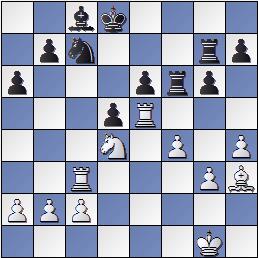
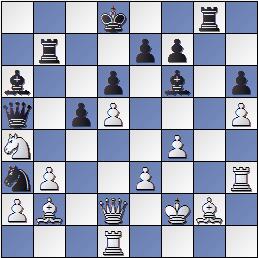
    (Position after 23...Bg7-h6 in Alexander Moiseenko (2670) - Artur Jussupow (2589), round 13)

    White sees the threat of 24...Be3, evaluates it as no big deal, and plays 24.Rxc7. Or rather, 24.Rxc7?? White is only half right: ...Be3 isn't a big deal right now or immediately after a rook trade, but it is in fact a VERY big deal! It just needs a little setting up, that's all:

    24...Qxf2+!!

    Oops. White resigned after 25.Rxf2 Rb1+, because after 26.Rf1 Be3+ - now! - drives the king into the corner and forces mate in two more moves.

    Thursday
    Dec022010

    This Week's ChessVideos Show: Viewer Questions

    Topics include the anti-Benko/Benoni with 3.e3, material imbalances, the psychology of blunders, the isolated d-pawn and rook endings. There's something for everyone, at least if "everyone" is limited to the sort of crowd likely to watch chess videos. And since this chess video is free (free registration required) and will be available on-demand for the next month or so, "everyone" should be happy.

    Monday
    Aug092010

    Endgame Blunders at the Rapid World Championship

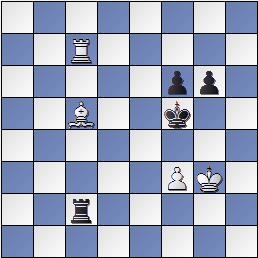
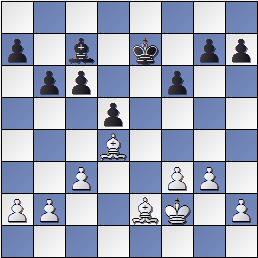
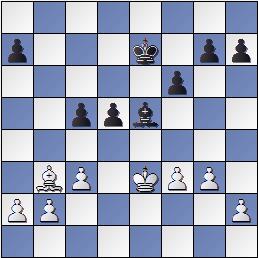
    Two games from this weekend's Grenke Rapid World Championship caught my eye as examples of what can happen to a player who is pressing for the win and gets excited about his chances - so excited he loses his sense of danger. Have a look.

    Monday
    Nov232009

    World Cup Results: Round 1, Tiebreaks

    Worst. Chess. Ever.

    I've never seen such bad chess from great players with their eyes open, at least not in these quantities. This might be unprecedented.

    But first, let me set the stage and discuss today's goings-on. Of the 64 first-round matches, 20 (not 19, as I miscounted earlier) were tied after the two "classical" games. (Or rather, what passes for classical chess now, thanks to FIDE. The time control is 90 minutes for the whole game, with 30 second increments and an additional 30 minutes given after move 40.) It used to be that the first round of tiebreakers was just two rapid (25' + 10") games, but now it's four. If it's still tied after that, then two games at 5' + 3", if still tied than another two at the same time control, and then two more, and then two more...in all, the players are given five blitz mini-matches before they are forced into an Armaggedon game where White gets 5 minutes to Black's 4 minutes + draw odds.

    Of the 20 matches, seven were settled after three rapid games, and seven more ended after the fourth game. That left six matches going to blitz, of which all but one - Tregubov-Akobian - ended with a winner. That match seemed to go on forever, before Akobian won three in a row and put Tregubov out of his misery by a 9-7 score.

    In the remainder of the post, I'll discuss upsets, games without blunders that caught my eye, and then finally enumerate the blunders I noted. (There may be more.) First, the upsets: Dominguez, Navara and Bacrot survived (in Navara's case with a bit of luck, as he was lost in game 4), but Sargissian lost to Li Chao, Sutovsky lost to Zhou Weiqi and Tiviakov lost to Iturrizaga. (In the other matches, the ratings were close enough that the upsets weren't that significant.)

    Next, the good and the interesting. In round 1.3, Shabalov resigned after 12 moves, which struck me as a pretty clever decision. Objectively, he was lost, but he could have kept going. The decision seemed to me motivated by a desire to forget the game as quickly as possible and to rest up and prep for the next game - and it worked!

    Moving on to round 1.5, I was impressed by Zhou Weiqi's technique against Sutovsky, found Shabalov-Baklan a very entertaining draw, and was both impressed and amused by Khalifman-Fier. Khalifman's strong play impressed me, while Fier deserved a (sarcastic) good sportsmanship award for continuing around 20 moves down a piece for absolutely nothing against the former FIDE World Champion. In the same round, Negi-Milov was an Evans Gambit, showing the hand of Nigel Short on the young Indian. The disastrous way the game ensued for White might have left Short wishing he could be dead for a moment so he could spin in his grave. Milov declined the gambit and obliterated Negi. Finally, Akobian-Tregubov was an excellent technical win by the American.

    In round 1.6, Tiviakov had White against Iturrizaga and theoretically the better chances to win the match, but he missed the nice shot 25...Nf3! and lost the game and the match. Baklan-Shabalov was another crazy game, and at the finish Shabalov had a rook against five(!) pawns. The game was drawn, but I'd be shocked if Shabalov wasn't winning until very near the end. (To his credit, despite all the setbacks I mentioned, Shabalov went on to win this match!) Savchenko-Shulman was funny in its own way, ending with Shulman being forced to give mate with bishop and knight. One of the curious aspects of the game was that it reached a position where Shulman had bishop and knight against a single, thoroughly stopped pawn. Rather than just winning it and giving mate, though, Shulman made 25 pointless moves first and only then captured it. I find it hard to believe a grandmaster of Shulman's caliber - in fact, a grandmaster of any caliber - needs more than the 10 second increments to perform the mate, but it was pretty smart of Shulman all the same. Supposing he gained eight seconds on his clock each time, that gave him an additional 200 seconds, which could come in handy just in case he happened to find himself stumped at some moment or other. My best guess, however, is that Shulman's interest in accumulating all that time had less to do with OTB worries and more to do with taking a restroom break. (If anyone knows, confirmation would be appreciated!)

    Now to the blitz rounds. In round 1.7, Akobian obtained two bishops vs. two knights, but it was a candidate for the worst bishop pair ever, and he got crushed. Andreikin-Nyback saw 1.Nc3 e5?!, and Nyback only just held on by a thread. (1...d5! is probably the best response, but anything other than 1...e5 is fine.) In round 1.8, Shabalov tried the Smith-Morra Pawn Loss Gambit against Baklan's O'Kelly Sicilian, and went on to win (though Baklan declined with 4...d3).

    On to part 3: blunders! There are so many it's incredible, but rather than describe them here I'll let you see them for yourself - have a look here.

    As for results and all the games, you can find them here, while pairings for round 2 are...I don't know where. If someone has seen a nice bracket chart, please post the location in the comments.

    Monday
    Nov162009

    The Worst Chess Nobody Sees

    Regular readers of this blog will recall that I often refer to the Bundesliga competitions as the best chess nobody sees. Many of the world's best players participate in leagues, with the German Bundesliga traditionally the strongest of them all, but because the events generally aren't well publicized to the chess community at large and takes place over many months, most fans barely know about it.

    That's a pity, but not always. Sometimes, even the greats screw up royally, and on those occasions the comparative obscurity of the Bundesliga is an advantage. So with apologies to Alexei Shirov, one of the best and most enterprising players of the last 20 years or so, you can find a surprising howler of his here.