Links

This form does not yet contain any fields.
    2.c3 Sicilian 2011 European Team Championship 2011 Russian Championship 2012 Capablanca Memorial 2012 Chess Olympiad 2012 European Women's Championship 2012 London Chess Classic 2012 U.S. Junior Championship 2012 U.S. Women's Championship 2012 US Championship 2012 Women's World Chess Championship 2012 World Rapid and Blitz Championships 2013 Alekhine Memorial 2013 Tal Memorial 2013 U.S. Championship 2013 World Blitz Championship 2013 World Championship 2013 World Rapid Championship 60 Minutes A. Muzychuk A. Sokolov aattacking chess Abby Marshall Accelerated Dragon ACP Golden Classic Adams Aeroflot 2010 Aeroflot 2011 Aeroflot 2012 Aeroflot 2013 Agrest Akiba Rubinstein Akiva Rubinstein Akobian Alejandro Ramirez Alekhine Alekhine Defense Alekseev Alena Kats Alex Markgraf Alexander Alekhine Alexander Grischuk Alexander Ipatov Alexander Morozevich Alexander Onischuk Alexander Stripunsky Alexandra Kosteniuk Alexei Shirov Almasi Amber 2010 Amber 2011 Amos Burn Anand Anand-Gelfand 2012 Anand-Gelfand World Championship Match Anand-Topalov 2010 Anastasia Bodnaruk Anatoly Karpov Andrei Volokitin Andrew Martin Android apps Anish Giri Anna Ushenina Anna Zatonskih Anti-Marshall Lines Anti-Moscow Gambit Antoaneta Stefanova apps April Fool's Jokes Archangelsk Variation Arkadij Naiditsch Arne Moll Aron Nimzowitsch Aronian Aronian-Kramnik 2012 Artur Yusupov Astrakhan Grand Prix 2010 attack attacking chess Austrian Attack Averbakh Baadur Jobava Bacrot Bangkok Chess Club Open Bazna 2011 Becerra Beliavsky Benko Gambit Bent Larsen Berlin Defense Biel 2012 Bilbao 2010 Bilbao 2012 bishop endings Bishop vs. Knight Blackburne blindfold chess blitz Blumenfeld Gambit blunders Bobby Fischer Bologan Book Reviews books Boris Gelfand Boris Spassky Borislav Ivanov Boruchovsky Botvinnik Botvinnik Memorial Breyer Variation brilliancy British Championship Bronstein Browne Brunello Budapest Bundesliga Camilla Baginskaite Campomanes Candidates 2011 Candidates 2011 Candidates 2012 Candidates 2013 Capablanca Carlsen Caro-Kann cartoons Caruana Catalan Cebalo Charlie Rose cheating Cheparinov chess and education chess and marketing chess cartoons chess history chess in fiction Chess Informant chess psychology chess ratings chess variants Chess960 ChessBase DVDs ChessBase Shows ChessLecture Presentations ChessVibes ChessVideos Presentations Chigorin Variation Chinese Chess Championship Christiansen Christmas Colle combinations Commentary computer chess computers correspondence chess Corsica Cyrus Lakdawala Danailov David MacEnulty David Navara Davies Deep Blue Deeper Blue defense Delchev Ding Liren Dmitry Andreikin Dmitry Gurevich Dortmund 2010 Dortmund 2011 Dortmund 2012 Dortmund 2012 Doug Hyatt draws dreams Dreev DVD Reviews DVDs Dvoirys Dvoretsky Easter Edouard Efimenko Efstratios Grivas endgame studies endgames Endgames English Opening Esserman Etienne Bacrot European Club Cup 2012 European Individual Championship 2012 Exchange Ruy Fabiano Caruana Falko Bindrich farce FIDE Grand Prix FIDE ratings Fier fighting for the initiative Finegold Fischer football Francisco Vallejo Pons Fred Reinfeld French Defense Ftacnik Gajewski Gaprindashvili Garry Kasparov Gashimov Gata Kamsky Gelfand Geller Georg Meier GGarry Kasparov Gibraltar 2011 Gibraltar 2012 Gibraltar 2013 Giri Greek Gift sacrifice Grenke Chess Classic 2013 Grinfeld Grischuk Grob Gruenfeld Defense Grünfeld Defense Gulko Gunina Guseinov Gustafsson Haworth Hedgehog Hennig-Schara Gambit Henrique Mecking HHou Yifan highway robbery Hikaru Nakamura Hilton Hjorvar Gretarsson Hort Horwitz Bishops Hou Yifan Houdini 1.5a Howard Staunton humor Humpy Koneru Ian Nepomniachtchi Icelandic Gambit Igor Lysyj Iljumzhinov Ilya Nyzhnyk Informant Informant 113 Informant 114 Informant 115 Informant 116 insanity Inside Chess Magazine Ippolito IQP Irina Krush Ivanchuk J. Polgar Jacob Aagaard Jaenisch Jaideep Unudurti Jakovenko Jan Timman Jay Whitehead Jeremy Silman Jimmy Quon John Watson Jonathan Hawkins Jonathan Speelman Jose Diaz Judit Polgar Kaidanov Kamsky Karjakin Karpov Karsten Mueller Kasimdzhanov Kasparov Kavalek Ken Regan Keres KGB Khalifman King's Gambit King's Indian King's Tournament 2010 Kings Tournament 2012 KKing's Gambit KKing's Indian Klovans Korchnoi Kramnik Kunin Larry Evans Larry Parr Lasker Lasker-Pelikan Latvian Gambit Laznicka Le Quang Liem Leinier Dominguez Leko Leonid Kritz lessons Lev Psakhis Levon Aronian Lilienthal Linares 2010 Lombardy London 2009 London 2010 London 2011 London Grand Prix London System Lothar Schmid Luke McShane Macieja Magnus Carlsen Main Line Ruy Malakhov Malcolm Pein Mamedyarov Marc Arnold Marc Lang Marin Mariya Muzychuk Mark Crowther Marshall Marshall Gambit Masters of the Chessboard Mateusz Bartel McShane Mega 2012 Mesgen Amanov Michael Adams Miguel Najdorf Mikhail Tal Mikhalchishin Miles Minev miniatures MModern Benoni Modern Modern Benoni Moiseenko Morozevich Morphy Movsesian Müller music Nadareishvili Naiditsch Najdorf Sicilian Nakamura Nanjing 2010 Navara Negi Neo-Archangelsk Nepomniachtchi New In Chess Yearbook 104 New York Times NH Tournament 2010 Nigel Short Nikita Vitiugov Nimzo-Indian NNotre Dame football Norway Chess 2013 Notre Dame football Notre Dame Football Nov. 2009 News Nyback Nyzhnyk Olympics 2010 Open Ruy opening advice opening novelties Openings openings P.H. Nielsen passed pawns Pavel Eljanov pawn endings pawn play pawn structures Pesotskyi Peter Heine Nielsen Peter Leko Peter Svidler Petroff Philadelphia Open Phiona Mutesi Pirc Piterenka Rapid/Blitz Polgar Polugaevsky Ponomariov Ponziani Potkin poultry Powerbook 2011 progressive chess QGD Tartakower QQueen's Gambit Accepted queen sacrifices Queen's Gambit Accepted Radjabov Ragger Rapport Rashid Nezhmetdinov rating inflation ratings Regan Reggio Emilia 2010 Reggio Emilia 2011 Reshevsky Reti Rex Sinquefield Reykjavik Open 2012 Richard Reti Robert Byrne robot chess Robson Roman Ovetchkin rook endings RReggio Emilia 2011 rrook endings RRuy Lopez RRuy Lopez sidelines Rubinstein rules Ruslan Ponomariov Russian Team Championship Rustam Kasimdzhanov Ruy Lopez Ruy Lopez sidelines Rybka Rybka 4 sacrifices Sadler Sakaev Sam Sevian Sao Paulo/Bilbao 2011 Sao Paulo/Bilbao 2012 satire Savchenko Schliemann Scotch Four Knights Searching for Bobby Fischer Seirawan self-destruction Sergei Tiiviakov Sergey Karjakin Sergey Shipov Shakhriyar Mamedyarov Shankland Shipov Shirov Short Sicilian sitzfleisch Slav Smith-Morra Gambit Smyslov Spassky spectacular moves Speelman sportsmanship Spraggett St. Louis Invitational stalemate Staunton Stonewall Dutch Suat Atalik Super Bowl XLIV Sutovsky Sveshnikov Sveshnikov Sicilian Svetozar Gligoric Svidler sweeper sealer twist Swiercz tactics Tactics Taimanov Tal Tal Memorial 2009 Tal Memorial 2010 Tal Memorial 2011 Tal Memorial 2012 Tal Memorial 2012 Tarjan Tarrasch Tashkent Teimour Radjabov The Chess Players (book) The Week in Chess Thessaloniki Grand Prix Three knights time controls Timman Timur Gareev Tomashevsky Tony Miles Topalov traps types of chess players underpromotion Unive 2012 University of Notre Dame upsets US Championship 2010 US Championship 2011 USCF ratings USCL V. Onischuk Vachier-Lagrave Vallejo van der Heijden van Wely Vasik Rajlich Vasily Smyslov Vassily Ivanchuk Velimirovic Attack Veresov Veselin Topalov video videos Vienna 1922 Viktor Korchnoi Viswanathan Anand Vitaly Tseshkovsky Vitiugov Vladimir Kramnik Vladimir Tukmakov Wang Hao Wang Yue Watson Welcome Wesley Brandhorst Wijk aan Zee 2010 Wijk aan Zee 2011 Wijk aan Zee 2012 Wijk aan Zee 2013 Willy Hendriks Winawer French Wojtkiewicz Women's Grand Prix Women's World Championship World Cup World Cup 2009 World Cup 2011 World Cup 2011 World Senior Championship WWijk aan Zee 2012 Yasser Seirawan Yates Yermolinsky Yevseev Yuri Averbakh Yuri Razuvaev Zaitsev Variation Zhao Xue Zug 2013 Zukertort System Zurich 1953 Zurich 2013

    Entries in Fabiano Caruana (14)

    Thursday
    May302013

    Thessaloniki Grand Prix, Round 7: Kamsky, Caruana Lead

    It was a very good day for citizens of the United States at the FIDE Grand Prix tournament in Thessaloniki as they went three for three while no non-citizen managed to win. Two of them, Gata Kamsky and Fabiano Caruana (who holds dual citizenship but represents Italy) are tied for first, while the third, Hikaru Nakamura, got his first win of the event.

    Kamsky's win was the cleanest, as he simply outplayed Rustam Kasimdzhanov with the black pieces in a Dutch Defense. Kasimdzhanov didn't make any obvious, egregious errors, but was beaten a bit at a time. The only really clear error came on move 27. White should have played 27.e4, temporarily sacrificing a pawn. His position was worse but wouldn't have been lost. Instead, he tried 27.exf4, but this opened the kingside files and Kamsky took speedy advantage.

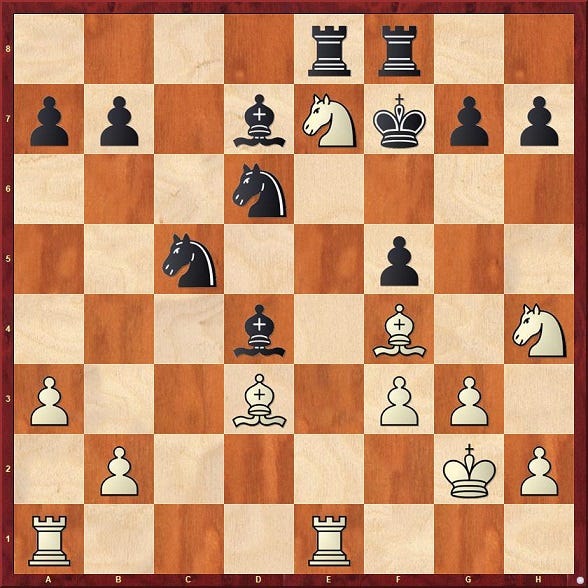
    Caruana's win wasn't so smooth. First one player and then the other had a very slight advantage, but it was Alexander Morozevich who was doing most of the pressing. The key moment came on move 47. Caruana threatened 47...Qb1+ 48.Nf1 Qxf1+ 49.Kxf1 Rh1#, and so Morozevich played 47.Nf1(??). That took care of the mate, but it was a blunder, and he was lost after 47...Nh3+!, forcing the win of the queen. Instead, 47.Nxf4 exf4 48.Nh5 sufficed for full equality. (Note that 48...Qb1+ 49.Kh2 Qxe4?? walks into mate starting with 50.Qc8+.) A nice gift for Caruana!

    The third decisive game was Nakamura's win over Veselin Topalov. Nakamura quickly won a pawn, but in light of the locked pawn structure and Black's good knight vs. White's bad bishop, a draw was the likelier result. Nakamura thought that Topalov's decision to exchange the last pair of rooks was a mistake, though even after the trade it wasn't clear that White could win. After the game Nakamura believed he could have won more easily with 44.Bxg6, but this is a mistake: after 44...Kxg6 45.Ke5 Nf5! 46.d6 Nd4! 47.d7 Kf7! 48.Kd6 Ne6 49.f4 Kf6! it's a draw.

    Another key moment came at move 50. Nakamura thought for half an hour on 50.f5 before playing it, and Topalov instantly replied with 50...Nd6, which looks like a serious (and fairly obvious) error. As Nakamura pointed out, Black needed to play 50...Kg7, aiming to park the king on f6 and bringing the knight back to d6. He didn't see a way to win after that, and it's not clear that there is one. (I'm not completely sure about that, but I'm not spotting one and the computer doesn't offer any sensible lines either.) Topalov's move allowed 51.f6, which in turns makes it possible for White's king to make further inroads.

    Nevertheless, the adventures hadn't yet come to an end. After 54...Nxb5 White had any number of clear winning approaches; for example, 55.Be8 Nd6 56.f7 Kg7 57.Kg5 followed soon by Ke6, or 55...Nd4 56.Kg4 Nxb3 57.d6 Nd4 58.Bf7 Nc6 59.Kf5. In both cases, White is not just winning but easily winning. Instead though, Nakamura played 55.Be2, probably anticipating 55...Nd6 and intending to meet it with 56.Bd3, cutting off the Black king. Instead, Black played 55...Nd4!, and now Nakamura had to think. He was down to his last 4-5 minutes until the second time control (achieved by making the 60th move). He looked nervous and his time was dwindling, but to his credit he played the absolutely correct - and probably only winning move - 56.Bh5!! To make this move he had to accurately calculate that 56.Bd3 failed, to recognize that 56.Bh5 won, and to have the inner strength to undo his last move. After 56.Bh5, 56...Nf5+ was probably a better try, but Topalov was lost in any case.

    The other three games were drawn, but only Bacrot-Dominguez merits mention. It was a very long game, but instructive in two ways. First, it shows both the strengths and the limits of the minority attack. White got what he wanted and saddled Black with a chronically weak c-pawn. That's the strength. On the other hand, Dominguez showed that the one weakness, by itself, wasn't the end of the world. He never had any counterplay, but even so it was very hard for White to convert this slight advantage into something major. The second instructive aspect came late in the knight ending, when Dominguez bravely and correctly sacrificed the aforementioned c-pawn with 60...Nd7. If Mikhail Botvinnik's maxim that "knight endings are pawn endings" were true, then White would have won. Instead, Black got just enough counterplay, and between that and White's backward e-pawn, Dominguez was able to hold the game.

    Round 8 Pairings:

    • Grischuk (4) - Caruana (5)
    • Dominguez (4.5) - Morozevich (3.5)
    • Topalov (3.5) - Bacrot (2.5)
    • Kamsky (5) - Nakamura (3)
    • Ponomariov (4) - Kasimdzhanov (3)
    • Ivanchuk (1.5) - Svidler (2.5)

    Friday
    Mar012013

    Zurich Chess Challenge: Caruana Wins!

    The second half of the Zurich Chess Challenge not only saw more decisive games than the first half (not difficult, since there were no decisive games in the opening cycle), it saw more interesting and volatile ones as well. In the end, Fabiano Caruana (send him back!) was the deserved winner; not so much because he played especially sterling chess (no one in the tournament did), but because he made the most of his chances (at least in the second half of hte tournament) while everyone else threw away half-points on a regular basis.

    Let's start with round 4, when the pairings saw Viswanathan Anand have the white pieces against Caruana, and Boris Gelfand have White against Vladimir Kramnik. Caruana had no problems in a Neo-Archangelsk Ruy, but Anand was okay too before essaying the slightly panicky 29.Rxe5. (29.Re2 was about equal, though visually Black's position seems somewhat threatening.) After the time control Anand was slightly worse, down the exchange for a pawn and generally active pieces, but on move 41 he blundered (his word) with 41.Bg2. (41.Be2 was better, keeping the N@d3 adequately guarded.) The problem with 41.Bg2 was 41...Nc8!, which not only swapped off White's best piece but also forced the subsequent exchange of White's remaining rook and the loss of White's a-pawn. After that the technical task was trivial (certainly for this level), so Anand gave up.

    As for Gelfand-Kramnik, the former world champion produced an ingenious piece sacrifice (22...Nxf2!), and several moves later enjoyed a clear advantage. To maintain it, Kramnik had to play 28...Bxe4 29.Nxe4 Qa7, but his immediate 28...Qa7?? could have lost the game after 29.R4e3. Of course the position was very complicated, and White was surely concerned about threats along the a7-g1, h6-c1 and a5-e1 diagonals, not to mention the d-file. (Okay, I mentioned it.) Objectively though, it was winning. Black must attend to the threat of Nxc6, and in case of 29...Bxg2 White interpolates 30.Ncxb5 and only after, say, 30...Qd7 plays 31.Qxg2 with a winning advantage after something like 31...Bxb4 32.Qa2! Bxe1 33.Rxe1. In the game, Gelfand played 29.Ncxb5?, and Kramnik again obtained a better, maybe even winning position, but failed to convert it, and the game finished in a draw.

    On to round 5. Kramnik built up a scary-looking kingside attack with White against Caruana, and although Black was objectively fine Caruana - in time trouble - went for short-term safety with an exchange sacrifice. It wasn't so bad, but thanks to his opponent's ongoing time trouble Kramnik was able to take over yet again, and had he played the consolidating 39.Rf3 he would have had excellent winning chances. Instead, 39.c5? got him into hot water, and he had to find some nice tactical ideas (40.c6!, 45.Re4!) just to save the game - which he did.

    Gelfand-Anand also featured an interesting but unnecessary and slightly mistaken exchange sacrifice. Gelfand enjoyed an advantage with White in a Catalan, and with 20.Qe1 or 20.Nd2 would have had the world champion under serious pressure. Instead, he chose to sac the exchange with 20.Rxc4?!, and then gave away the rest of his advantage several moves later with 23.Rb7 (23.Rc4 kept a pleasant edge), mistakenly allowing the exchange of his last rook. (The same mistake Anand made against Caruana the round before, but here with two pawns for the exchange Gelfand had just enough of a margin to be alright.) Anand might have even pressed a little with 29...g5, preventing h4 which freed White's king to centralize. Missing or forsaking that opportunity, Gelfand drew without any real trouble.

    On to the final round. With a win over Anand, Kramnik could still hope to tie Caruana for first. Despite having the black pieces, Kramnik obtained an initiative in a complicated 4.d3 Anti-Berlin, but an inaccurate 20th move and a howler on move 21 cost him the game and finished his tournament with a rude bump. Kramnik had decent chances to score at least 2.5 points in the final three games, but only managed a single point. Not the way to go into the Candidates in two weeks!

    Likewise, Gelfand finished with a winless -1 score after losing his last round game to Caruana. Early in the middlegame he sacrificed a pawn to reach a position where his activity was probably just about enough to hold a draw, but Caruana, like Carlsen, requires his opponents to prove their ability to hold a position over many, many moves before letting them off the hook. Gelfand seemed to have decent drawing chances after the first time control, with all the pawns on one side of the board and the ideal h5-g6-f7 defensive pawn chain. His decision to push the pawns looked dangerous, but had he played the normal 50...hxg4+ it seemed he would have pretty decent chances to hold. His 50...fxg4+ looked odd - why give White an unearned passed e-pawn? - but even so the outcome was only certain after the incredible 55...h4?? It's hard to know what he even thought this achieved. Maybe he thought that after 56.gxh4 g3 57.Bg1 Bh6 he'd be able to play 58...Bxf4 59.exf4 Rxf4 and pick up the h-pawn too, reaching a drawn rook vs. rook and bishop ending? White has many ways to thwart that plan, however, including the move Caruana chose: 58.Kg2. Black resigned after that, since 58...Bxf4 59.exf4 Rxf4 60.Kxg3 keeps the h-pawn.

    So Caruana finished with a convincing, undefeated +2 in the tournament, and earned his way back to #7 on the rating list. Like Carlsen, his play is rarely "shiny" or characterized by dramatic opening successes; rather, like the great Norwegian (and players like Smyslov and Karpov before them), he makes a lot of very good moves, and is remarkably resilient both in defense and in prosecuting the slightest advantage.

    Anand's play wasn't fantastic, but resilience and a last-round gift made up for his own unforced error against Caruana, and his 50% score was enough for clear second.

    Kramnik and Gelfand can both be somewhat disappointed with their play and their results, but getting in six games with great, tough opponents playing unfamiliar positions (due to avoiding their real opening prep) will surely help warm them up for the Candidates. And that should be a fantastic event!

    Saturday
    Feb232013

    Zurich Chess Challenge, Round 1: Two Draws

    Round 1 of the Zurich Chess Challenge is history, and not the sort of history that will be studied years later. As expected, Vladimir Kramnik played something a little offbeat with White (1.Nf3 c5 2.b3), undoubtedly saving his real preparation for when it counts - next month's Candidates' tournament. Boris Gelfand didn't have much trouble with this, and were it not for the tournament rule that if players agree to a draw in fewer than 40 moves they must play an exhibition rapid game immediately afterward, they probably would have called it a day much sooner than they did. To be fair, Kramnik did try a bit, but there was little to be had.

    The game between Fabiano Caruana and Viswanathan Anand was more interesting. Anand has had some trouble over the years against the 6.Be3 e5 7.Nf3 anti-Najdorf line - most recently earlier this month against Caruana in the Grenke tournament. Today he came out of the opening in good shape, and after 22...d5! he had equalized. Caruana managed to keep causing problems though, and after 31.g4! Qc8 32.Rb1! Anand had some difficulties with his semi-stranded rook on c2. Fortunately for Anand, Caruana was very short of time, and by the end of the first time control (completed after each side's 40th move) Anand wound up with an extra pawn. Caruana eventually held the draw, but it's clear that the world champion failed to make the most of his chances.

    You can replay the games here (with my annotations to Caruana - Anand). Tomorrow's (Sunday's) pairings are Kramnik - Anand and Gelfand - Caruana.

    Saturday
    Feb232013

    Zurich Chess Challenge Underway

    Only four players are involved in the Zurich Chess Challenge, but it's a very impressive field! There's world champion Viswanathan Anand, fresh from his come from behind win at the Grenke Chess Classic; there's world #2 and former world champion Vladimir Kramnik, who has been playing very well lately and will participate in the Candidates tournament next month in London; there's Boris Gelfand, who came very close to defeating Anand for the title last year and will also be in the Candidates; and finally, there's Fabiano Caruana, who nearly won Grenke and will likely be a contender for the title in the near future.

    The first round started a little while ago, with the pairings Caruana-Anand and Kramnik-Gelfand. The tournament is a double round robin, so color allocation isn't really an issue, but nevertheless a blitz preliminary was held yesterday to determine pairing numbers. In the first cycle, Caruana and Kramnik both beat Anand and Gelfand and then drew with each other, and in the second cycle they both beat Anand and drew Gelfand. (Anand beat Gelfand in the first cycle and drew in the second, and thus finished tied for last.) Finally, Caruana beat Kramnik with Black in the last round to win and get pairing #1.

    The tournament website is very good, with a live stream and commentary (for the classical games, at least; the blitz is still available but without commentary).

    Predictions? I'm finding it hard to prognosticate: Kramnik and Gelfand will surely hide their real prep, while I still don't think Anand is really playing anywhere near his peak - a good percentage of his recent wins (e.g. vs. Aronian and Fridman) were primarily based on strong preparation. That leaves Caruana, who is young, hungry, played well in the Grenke tournament and does well against Kramnik. He probably plays too much, but when one is 20 there is energy to burn. I'll pick him to win the tournament.

    Saturday
    Feb092013

    Grenke Chess Classic, Round 3: Caruana Wins Again, Leads by a Full Point

    Round 3 of the GRENKE Chess Classic continued the pattern from the first two rounds: two draws and a single win. The games Viswanathan Anand vs. Georg Meier and Michael Adams vs. Daniel Fridman both finished in relatively uneventful draws, but the battle between pre-round co-leaders Fabiano Caruana and Arkadij Naiditsch was a very complicated, see-saw affair. When Caruana chose 11.Kb1 rather than 11.a4 Black obtained an advantage (or so the players thought). Black's bishop pair and the coffin pawn on a3 forced White to be careful, but somewhere between moves 17 and 20 Naiditsch did something wrong and White obtained the advantage with 21.Bc4 Kh8 22.Rxd4. Anand had just finished discussing his game and offered a few thoughts about this one around this point, and he felt that White had a pretty big advantage.

    Engines agree that White is better, but not by much, and when Caruana failed to play very precisely Naiditsch gained the upper hand. After Caruana's 22.Qe3? Black may have been winning with 22...Qxg3 23.Rxe2 Qg6+ 24.Bd3 Qh5, but the position is still complicated. The whole thing is complicated! Naiditsch chose 22...Qg2? instead, but after 23.Nd4! White was better (though not decisively).

    The players were also in serious time trouble, avoiding flagging only by virtue of the 30-second increments. As a result, the game degenerated into a battle of tactical instincts. Naiditsch had the right idea with 36...g5, aiming to bring the long-suffering bishop on h6 back into the game. The right idea, but the wrong execution. 36...g6 would have maintained roughly equal chances, but 36...g5?(?) 37.fxg5 Bf8 38.Nf4! was a crusher; in fact, it brought about Black's immediate resignation.

    After 3 rounds, Caruana has 2.5 points, already good for a point lead over his closest pursuers. There are three of them: Anand, Naiditsch and Fridman; Adams and Meier bring up the rear with a point apiece. The round 4 pairings: Fridman-Anand, Naiditsch-Meier and Adams-Caruana.

    Sunday
    Dec092012

    Caruana To Play in the U.S. Championship?!

    It seems that Fabiano Caruana has received an invitation to play in the 2013 U.S. Championship, and he has tweeted his intention to play, schedule permitting. For years I've jokingly appended "send him back" when reporting news of Caruana's successes, but unless he's moving back and planning to represent the USA in international events I don't get this move by the US Chess Federation at all. He doesn't live here and isn't doing a thing for chess in the United States, so why are we paying him to show up and take money and an opportunity away from someone who lives and works here? In American politics, we ridicule as "carpet-baggers" politicians who move to a district just to get elected there; here, we're "electing" Caruana without even making him move. If he's changing federations, he's welcome back, but otherwise this is insane.

    [HT: Kevin Connelly]

    Friday
    Nov302012

    Tashkent, Round 7: Karjakin, Caruana Win, Lead

    Alexander Morozevich enjoyed clear first coming into round 7 of the FIDE Grand Prix in Tashkent, but with four players just half a point behind it wasn't the most secure lead in chess history. Two games were decisive today, and unfortunately for Morozevich both (Fabiano Caruana and Sergey Karjakin) - were in the aforementioned chase pack. Worse still, one of those wins - Karjakin's - came at his expense. And worst of all, perhaps, it came with a beautiful finish that's bound to be widely anthologized.

    First though, Caruana's win. He had equalized with Black against Leinier Dominguez in a 3...Qd6 Center Counter, but there was still plenty of play after 30 moves. Unfortunately for Dominguez, he chose 31.c4?, which may not have lost but soon left him a pawn in arrears with only questionable compensation at best. Perhaps with perfect play the draw could have been held, but Dominguez was unable to meet that lofty standard, and Caruana (send him back!) won the game.

    As for Karjakin-Morozevich, have a look, here.

    Karjakin and Caruana share first place with 4.5/7; Morozevich, Shakhriyar Mamedyarov and Rustam Kasimdzhanov are half a point behind with four rounds remaining.

    Saturday
    Oct132012

    Carlsen Wins Final Masters In Blitz Playoff Over Caruana

    The Final Masters came to a conclusion today, and Magnus Carlsen won - deservedly - against Fabiano Caruana in a blitz playoff. Both players finished with +3 scores, each losing only one game in the event - to each other. Caruana went +3 in the first cycle and even in the second, while it was the reverse for Carlsen. So why do I say Carlsen was the deserved winner, when both players had such similar results?

    The answer came in today's round, before the blitz games. Both Carlsen and Caruana had Black, against Levon Aronian and Francisco Vallejo, respectively. Carlsen drew with Aronian, but he had to sweat a while, as Aronian enjoyed a definite and nagging edge for a long time in a very old-fashioned Queen's Indian. Nevertheless, once he equalized, even though he had no legitimate chances to win at all, he played on a bit longer when Aronian offered a possible repetition. He took chances early in the game, in the hopes of reaching a position where he could fight for a win, and then even later fought when there was practically nothing left to fight for.

    Contrast that with Caruana's game. Caruana is a big specialist in the Neo-Archangelsk variation of the Ruy, but chose instead to play the Zaitsev. Trying to avoid some preparation? Maybe, but he wasn't worried about that earlier in the event, even though he's aware that every professional on the planet knows he plays the line. Anyway, Vallejo shamelessly played the Ng5-f3 repetition, daring Caruana to choose a different system. Not particularly admirable on Vallejo's part, but when you're -4 and just turned what could have been 2.5 points (on classical scoring) the past three rounds into a single half a point, wanting to put an end to the event is pretty natural. But why is Caruana giving him a break? Vallejo isn't a bad player, but he's not doing well and he's the lowest-rated player by a considerable margin. If you're not going to play for a win against the bottom marker by rating and score, who are you going to play for a win against?

    Viswanathan Anand and Sergey Karjakin played a lively draw in a sharp line of the Slav, and so the final standings (not counting the tiebreak) looked like this:

    1-2. Carlsen, Caruana 17 (on 3-1-0 scoring; their "real" score was 7-3)
    3. Aronian 11 (5-5, with one win and one loss)
    4. Karjakin 10 (4.5-5.5, with one win and two losses)
    5. Anand 9 (4.5-5.5, with one loss)
    6. Vallejo 6 (3-7, with four losses)

    On to the blitz (4' + 3") playoff. Carlsen had Black in game one and played the Berlin Defense. Carlsen managed to artificially isolate White's e-pawn and win it, and he subsequently converted his material advantage in a rook ending. The second game was a bit of a farce. It's very difficult to win on-demand with Black - especially against Carlsen - so Caruana probably felt the need to play a riskier and somewhat unfamiliar opening. Carlsen played somewhat untheoretically as well, but clearly had a better feel for the opening:

    1.e4 c5 2.Nf3 e6 3.g3 b6 4.Bg2 Bb7 5.Qe2 d6 6.d4 cxd4 7.Nxd4 Nf6 8.0-0 Nbd7 9.Rd1

    Here White is threatening a standard trick that more often arises from the g3 line against the Taimanov/Paulsen. Caruana either didn't know it, didn't suspect it, or just grossly underestimated it. (Ironically, he made a similar mistake against me in a blitz game a couple of years ago, and was extremely fortunate to draw - I had a winning position and he had no material, but I ran out of time.) Black needed to play something like 9...Qc7/Qc8/Qb8; instead:

    9...a6? 10.e5

    and now another big error:

    10...Bxg2? 11.exf6

    Black is completely lost. If 11...Bb7, 12.Nxe6 finishes the game, but after

    11...Bh3 12.Qh5

    was curtains. (If 13...Bf5 14.Nxf5 exf5 15.Qe2+/15.Re1+ followed by 16.fxg7 and 17.f4 wins a piece.) Caruana kicked on for five more moves (12...Qxf6 13.Qxh3 Be7 14.Nc3 Qg6 15.Nc6 Ne5 16.Nxe7 Kxe7 17.Bf4) and called it a day.


    Monday
    Sep242012

    The Daily Update: London & Sao Paulo/Bilbao

    Two super-tournaments at once! Of the top 18 players on the Live Ratings list, all but five are busy in either London or Sao Paulo/Bilbao (the first cycle is in Sao Paulo, and then they'll shift over to Bilbao for part two).

    We're up to round 4 in London, and it was a good day for two of the three G-stars, as Gelfand and Grischuk won their games. (Giri only drew.) In Grischuk's case, it was the result of a classy win over Mamedyarov. Playing a slow system in the Ruy with d3 (it has become all the rage these days, avoiding forcing lines and making Black play chess rather than demonstrate preparation), Grischuk built up a nice space advantage and then sacrificed a piece for three very good pawns. Soon Mamedyarov gave the piece back for those same three pawns - or rather, for three different pawns. White's passed c-pawn was the most important pawn on the board, and to eliminate it Mamedyarov wound wind up two pawns down in a lost rook ending, and so he resigned.

    Gelfand's battle with Wang Hao took a different course. With White in a Catalan, Gelfand came out of the middlegame with an extra pawn and good winning chances. In his view (see the interview at the official site, linked above), the chances of a win or a draw were about 50-50, but Wang Hao defended resourcefully and finally reached a drawn ending. In the end, there was one last problem to solve, and 55...Kf8 would have solved it! Instead, apparently forgetting about White's pawn on f4, Black played 55...Kh7?? and resigned after 56.Kf7, as mate cannot be stopped (56...Kh6 doesn't help as 57...Kg5 is not a legal reply to 57.Rh1#).

    So with his second win, Gelfand reclaims the sole lead he enjoyed after round 1. There's still a long way to go, and only after tomorrow's round will the players pass the halfway point. Here are the pairings, with the players' scores in parenthesis:

    Round 5 Pairings:

    • Topalov (2) - Leko (2.5)
    • Dominguez (2) - Nakamura (2)
    • Wang Hao (1.5) - Kasimdzhanov (1.5)
    • Mamedyarov (2) - Gelfand (3)
    • Ivanchuk (1.5) - Grischuk (2.5)
    • Adams (2) - Giri (1.5)

    Now to Sao Paulo, for round 1 of the first leg of this double-round robin tournament. Two of the three games were decisive: one very speedily, the other an entirely long, drawn-out affair. Aronian sprung some nice preparation on Karjakin he had been holding on to for a long time. After White's 18th move in a comparatively lively Queen's Indian (at times analogous to a "speedy snail"), Aronian was up the exchange for a pawn, but Karjakin had counterchances on the long a8-h1 diagonal. It seems that there were little improvements available for both sides along the way, but the key moment came after Aronian played 23.f3. Here Karjakin had an attractive equalizer - one he saw, too, but apparently in a slightly different position. The key move was 23...Nd3!!, when after 24.Rxd3 Qxc4 Black is down a rook for a pawn, but White's king is in a world of trouble. The greedy 25.Re3 loses after 25...Ba6! 26.Ne2 Qc2!, when White cannot save the knight with 27.Kf2 because of 27...Bc5. Instead, 25.Rd8 improves, but this is only enough for equality after 25...Ba6 26.h4, leaving Black nothing more than a perpetual check.

    Instead, Karjakin's 23...Nd7 took the heat off, and after 24.Ne4 Qa4? the game was lost; the passive 24...Qc8 would have allowed Black to keep resisting. I'm not sure what Karjakin missed, but after 24...Qa4? 25.Rxd7 Bxe4 26.Rd8 White's king was safe while Black's was not, and the game was over a few moves later.

    Viswanathan Anand played his first official game since retaining his world championship title against Gelfand several months ago, and he kicked off the tournament inauspiciously, drawing with White against Vallejo Pons. In fact, he even managed to come out of the opening with an inferior position, but by the end of the game, many moves later, he obtained a purely symbolic edge when the draw was agreed.

    Finally, Caruana-Carlsen was an epic struggle that went more than 90 moves and saw both players take turns pressing for a win. Carlsen tried the Winawer French, and his reward was a lousy-looking position as soon as move 14. It didn't just look bad; it was bad, but when Caruana failed to take advantage (e.g. with 16.Bxg6 hxg6 17.Rh3 +/-) Carlsen gradually took over the game.

    Surviving the opening took a lot of time, though, and as the first time control loomed Carlsen started to squander his advantage. Most commentators, and the players as well, criticized first 31...Nxe3, and then the plan with 34...h5 and 35...g4. That series of moves took Caruana from a sure loss in the long run to a highly defensible fortress in an opposite-colored bishop ending. Carlsen is nothing if not persistent, however, and he spent the next several hours trying to breach the fortress. Looking for a way in required a lot of thought, though, and when he decided on move 76 to avoid a perpetual by tucking his king away on h2, he was short of time and almost down to the 10-second per move increment.

    It was at this point that Caruana decided to go for it with 77.cxb4 Rxb4 78.Rxe6 Be4 79.Rxe4!? The sac may not have been 100% sound, but it was incredibly dangerous for Black, and with almost no time to solve the problems Carlsen was in serious trouble, practically speaking. The computer expresses some skepticism about Caruana's sacrifice (80...Rb2!!, for instance, may be winning), but it took just two moves for everything to go upside down. Carlsen's 80...Kg2 was very natural, but it threw away the (hard to find) win, and then after 81.Ke3 Black had to play either 81...Rb1! or the flashy 81...Rb3+(!!) to hold the balance. Instead, he chose the wrong time for ...Rb2, and after 82.d5! he was lost. His 86...h4 was a terrific try, but Caruana responded perfectly and won the game.

    A brief comment: Few things in sports/competition bother me as much as seeing a player defeat himself. It drives me bonkers when I do that - and as a result I think I do it relatively rarely. But this is not really such a case, to my mind. Of course the loss could have been avoided - Carlsen could have offered a draw (well, could have acceded to a repetition; draw offers are forbidden in the tournament) at practically any time from move 30 on, and it would have been accepted before his vocal cords stopped vibrating. But he was always better, and was always justified in continuing. Playing 76...Kh2 entailed risk, yes, but it was a reasonable risk, and self-respect as a professional also entailed continuing the fight. He lost this game, but this fighting attitude has and will garner far more wins in the long run. So rather than apportioning blame to Carlsen or offering some idiotic comment to the effect that he was unlucky, I would rather give full credit to Caruana (send him back, especially as he practically never lives in Italy anyway!). He didn't get discouraged after blowing a serious advantage, but fought on forever, and after five or six hours of play had the gumption to fight not just for the draw but for the win! Well done.

    Round 2 Pairings: Vallejo - Carlsen, Karjakin - Caruana, Anand - Aronian.

    Sunday
    Jul222012

    Dortmund 2012: Caruana, Karjakin Tie For First

    And so another edition of Dortmund comes to a close, and for a change Vladimir Kramnik was not the winner. (He came close and had his chances, but for now he's "stuck" at 10 wins there.) Officially, the title goes to Fabiano Caruana for having more wins than Sergey Karjakin (I'm not sure why that should be a tiebreaker - it's far from obvious that it's intrinsically better to have a win and a loss than a pair of draws - but no one asked me!), but the two both won their last-round games and finished with identical 6-3 scores.

    Caruana's game was in fact the first to finish. Against Mateusz Bartel he chose his favorite, the Gruenfeld, and Bartel replied with the Rb1/Be2 line, but with 11.Qd2 rather than the more enterprising (but deeply worked-out) 11.Bd2. Teimour Radjabov had played 11.Qd2 against Caruana at the Tal Memorial earlier this year and obtained an overwhelming advantage, so Bartel must have been hoping for a little of that action himself. Obviously Caruana had prepared, however, and varied with 12...e6 from his earlier 12...Rd8.

    On move 15, 15.Bb4 is both more popular and more successful in the database than Bartel's 15.Rc7 (played after nine minutes), but there haven't been any high-level tests of either move. (I note that Houdini 2 prefers 15.Bb4 as well, but prefers the untested 15.Rfe1 as its #1 choice.) The engine isn't enamored by Bartel's 16th move either; essentially, the bottom line in this variation is that White's pieces look like they're swarming all over Black's position, but Black always has sufficient resources - not to mention an extra pawn and targets on d4 and a2.

    White's 18th move was inaccurate as well, according to the oracle; it prefers 18.Be7 Re8 19.Bb5 Nc6 20.Bxc6 Bxc6 21.Nxf7 Rec8 22.Rxc8+ Rxc8 23.Nd6 Rc7 24.Rc1 Rxe7 25.Rxc6, "thinking" that after 25...Bxd4 Black's extra pawn will be difficult-to-impossible to exploit. Bartel's 18.Bb5 (still in the databases) cost him 12 minutes, but he was still following a couple of old (1996 and 2000) correspondence games. Only after Bartel's 23rd move did they reach new ground, and by then Bartel was clearly worse, and his new move was a disimprovement. Black was winning, and with perfect play Caruana finished him off after just 27 moves.

    That guaranteed that Kramnik could not join in a tie for first, but he still finished on a high note, crushing Georg Meier with a mating attack. (Very sportingly, Meier allowed Kramnik to deliver the mate - not everyone would do that, especially when his king is sitting on d5!) An English turned into a Semi-Tarrasch where White had the isolated d-pawn; a structure which saw Kramnik win a string of beautiful games (including two over Anand) around the turn of the century. Meier played an unusual move, 11...Nde7, and Kramnik invited him to go pawn-grabbing.

    Maybe Meier should have played the circumspect 16...Qe7, because 16...e5(?) gives the knight access to d5, opens the Bc4's diagonal and doesn't even inconvenience the Bc7 because of f4. Maybe 20...Qg5 would have minimized the damage, and on move 23 Meier had to give up the exchange. 23...Re8 is simply a blunder, but one that will live on for a few generations of tactics anthologies. Kramnik played the remaining 10 moves with the accuracy of a computer, and delivered the aforementioned mate.

    Now let's turn to the event's co-winner, Sergey Karjakin. Jan Gustafsson played the Caro-Kann against him, which is a double surprise: "Gusti" is renowned as a 1...e5 specialist, while Karjakin has a tremendous track record of bludgeoning the Caro-Kann with the Advance Variation. As it turns out, both players abstained from e5, as Karjakin chose the Classical lines with 3.Nc3. The players were in well-worn territory for a long time, though 17.Be3 isn't as usual as 17.Ne5.

    Gustafsson's 18...Nf6 was a new move and a tacit draw offer, but obviously with first place on the line, the white pieces and a big rating edge that wasn't going to happen. After 19.Ne5, it looks like Karjakin was gifted with a better version of the 17.Ne5 line, as the bishop is more usefully tucked away on c1 - on d2 it blocks the d-pawn's defense by the rook. After 17.Ne5 Qe4 White doesn't play 18.Qf1, as Black can safely take on d4. Here, 20.Qf1 was perfectly sensible, and White gained a useful tempo a little later with 21.f3.

    Gustafsson's 21...Qh7 was another questionable decision. It's a nice diagonal and the queen helps secure the kingside - maybe - but White enjoyed a significant edge occupying the abandoned center. The final consequential error was 26...f5. Black desperately wanted some activity for his pieces, but White's pieces were better prepared for an open position. A catastrophe quickly ensued on g7, and Black did not make it to the time control.

    Ruslan Ponomariov seemed a likely candidate to join the tie for first, with White against Daniel Fridman, but it was not to be. They were in new territory in a Tartakower QGD as early as move 13, as they reached a normal position but where White had gotten in e3 for free. (Fridman apparently thought this was a neutral change or maybe slightly detrimental to White's prospects.) The play sharpened when Black played 18...dxc4, creating serious pawn majorities for both sides. 18...bxc4 was safe and easy, but Fridman showed some ambition at this point. 19...b4 was another sharp decision, enabling White to eliminate Black's majority at the cost of an exchange - but when one side gets two pawns for the exchange can we really speak of the "cost"?

    The question was whether White could succeed in advancing his central majority. Ponomariov managed to push a pawn to d7, but at the cost of his a-pawn, and with Fridman's a-pawn on the loose he wisely decided to force Fridman to force a perpetual. (The "alternative" was 29.Qc6, but only the most naive computer user could consider this a real winning try. Black makes what are generally obvious moves and it's still dead even: 29...a3 30.Qc5 Qd2 31.Qxa3 Qd1+ 32.Kg2 Qd5+ 33.f3 Rb8 [of course not 33...Qxb5?? 34.Qxf8+ with an extra queen now, after 34...Kh7 35.d8Q, or inevitably, in the winning pawn ending after 34...Qe8 35.Qxe8+ and so on] 34.Qa6 Rd8 35.Qc8 Qa2+ etc.)

    Finally, two of pre-round co-leaders faced off in the battle between Arkadij Naiditsch and Peter Leko. As if to make up for Karjakin-Gustafsson, they played an Advance Caro-Kann; amusingly, Naiditsch's 8.Na3 was preferred by Leko himself last year against Roiz, as opposed to 8.dxc5 as chosen by Karjakin against Grischuk and Carlsen (also last year). Leko deviated from Roiz's play with 11...d3, and Naiditsch's 12.b4 was a new move. White wound up with an extra pawn, but his unwieldy mass on the queenside and the ...a5 break kept the chances balanced.

    The assessment remained equal throughout, but not for want of trying or a lack of imbalances in the position. In the end, Naiditsch had decimated Black's queenside, but Black's counterplay led to a fairly simple but spectacular perpetual check combination that saw Leko sac a bishop, then the exchange and then a rook. (One might joke that Leko's drawing mojo is so powerful he can draw even when he's two rooks down!)

    So that brings this edition of the Dortmund super-tournament to a close, one of the hardest-fought I can recall. Here are the final standings:

    1-2. Caruana, Karjakin 6 (of 9)
    3-6. Ponomariov, Naiditsch, Leko, Kramnik 5.5
    7. Meier 4
    8. Fridman 3.5
    9. Bartel 2
    10. Gustafsson 1.5