A Rare Case of Hyperchevalierism
 Thursday, February 4, 2010 at 12:33AM
 Here's something you don't see every day:
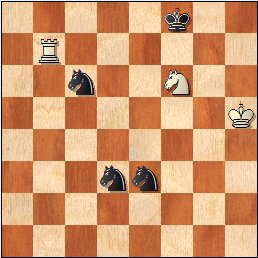
This, as a reader was kind enough to inform me, was the final position of the game Sergienko-Vescovi from the ongoing Moscow Open. The game was agreed drawn here as White has perpetual check with Nf6-h7-f6. (That's not true, strictly speaking, because Black can avoid it with ...Kh8 or ...Kd8, but the former allows Rh7# while the second loses a knight to Rd7+. But it is true from a practical standpoint.) However, it's not the result that's especially interesting but Black's knight surplus. Not only has he had the three knights for quite a while (he knighted on move 56; it's White's 65th here), but the underpromotion wasn't a joke.
I searched Mega2009 (didn't check Mega2010 on my other computer), and if I did the search correctly, there were just 10 games with three (or more) knights, and in every case it was a joke: the underpromoter was way ahead in material and having fun against an opponent who didn't seem to understand that resignation is permitted in all of FIDE's member nations.
For problemists it's another story. In my old (2000) edition of van der Heijden's Endgame Study database there are 75 entries (out of 58801) with three or more knights. But it looks as if Vescovi has broken new ground in the realm of tournament chess. Here's the full game.
Dennis Monokroussos
On Tim Krabbé's Chess Curiosities site, he has a page for chess records. In the "Promotion" box you'll see an entry for "Longest 3-Knight sequence", and there's a game between Skrobek and Kornasiewicz played in Wisla 1992 that, alas, tops our game. Still, Sergienko-Vescovi is a great rarity, even if it can't boast of uniqueness.
Reader Comments (6)
If white's rook was removed from the board, would the resulting 3 knights v. 1 knight position be a win for black? (I kinda suspect not, but can't be sure...)
3 knights vs. 1 is a win. Wikipedia has a good article on pawnless endgames:
Wikipedia
There are studies based on this, but I can't give an example right now.
Note that even 2 bishops vs. 1 knight or 3 knighst vs. 2 knights can be won, but maybe not within 50 moves.
Furthr reading:
Krabbé (294)
Effect_of_tablebases_on_endgame_theory
Nick: The answer is yes, and you can prove it for yourself on the Shredder tablebase site.
Dennis, thanks for the extra research. It's good to have the added context on the rarity of this event.
Thanks for that- the Shredder site is a great free resource I didn''t know about.